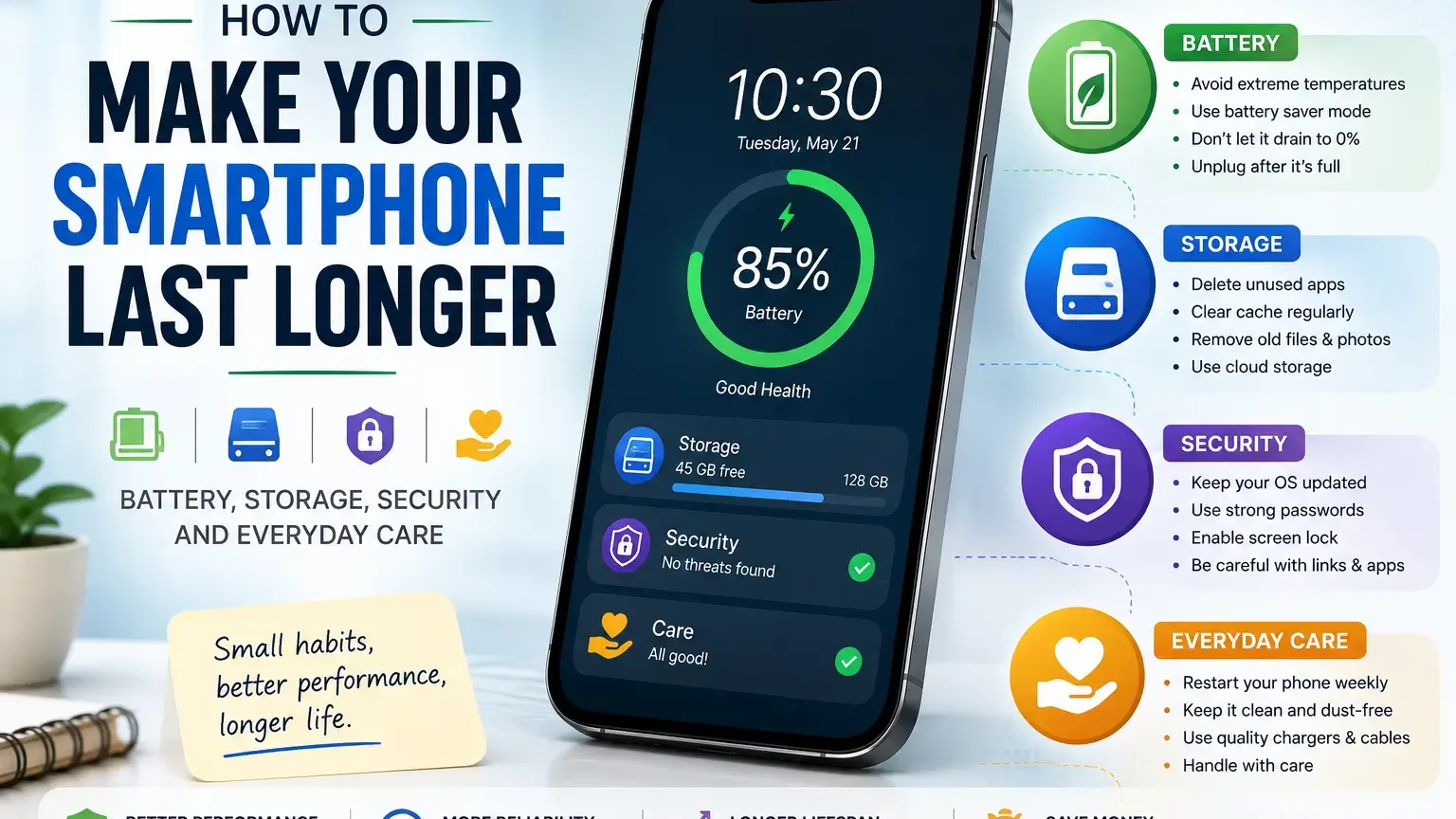
A smartphone can remain useful for years when it is chosen well and cared for sensibly. Most people do not need extreme routines, complicated tools or fear-based advice. They need a phone that stays charged, secure, organized, physically protected and easy to use. The difference between a device that feels old after eighteen months and one that remains comfortable for several years often comes from ordinary habits.
This guide explains how to extend the useful life of a smartphone without turning maintenance into a hobby. It covers battery health, charging, heat, storage, app cleanup, updates, backups, cases, water resistance, cleaning, notification control, security, repairs, travel habits, hand-me-down use and resale preparation. It is written for ordinary users who want fewer problems and better long-term value.
The advice applies to both iPhone and Android. Specific menus may differ, but the principles are similar: reduce heat, keep storage healthy, update responsibly, back up important data, protect the body, manage apps and repair at the right time. A phone that is cared for in these simple ways will usually feel calmer, safer and more valuable.
Table of Contents
- Why Smartphone Longevity Starts With Habits
- Battery Health: The Core of Long-Term Comfort
- Charging Habits That Actually Help
- Heat Is the Hidden Enemy
- Storage Management Prevents Slowdowns
- App Hygiene: Keep What You Use, Remove What You Do Not
- Software Updates: Stay Current Without Being Careless
- Backups Are Part of Phone Care
- Protect the Screen and Body From Day One
- Water Resistance Does Not Mean Waterproof Forever
- Clean Ports, Speakers and Cameras Carefully
- Notification Control Makes a Phone Feel Faster
- Security Habits That Extend Useful Life
- Camera and Media Habits for Long-Term Storage
- Performance Maintenance Without Risky Tricks
- Repairs: When Fixing Beats Replacing
- When to Factory Reset
- Travel Habits That Protect Your Phone
- Kids, Family Phones and Hand-Me-Down Devices
- Resale and Trade-In Preparation
- Signs It Is Time to Replace the Phone
- Monthly Smartphone Maintenance Routine
- Accessory Choices That Reduce Wear
- Cloud Storage Without Losing Control
- Digital Wellbeing and Battery Life
- Protecting Accounts Before You Lose the Phone
- Final Longevity Checklist
| Problem | Likely cause | Practical fix |
|---|---|---|
| Battery dies early | Aging battery, heat, heavy background use | Check battery health, reduce heat, review app activity |
| Phone feels slow | Nearly full storage, old apps, weak battery, clutter | Free storage, update apps, restart, remove unused tools |
| Photos look hazy | Dirty lens, damaged glass, poor lighting | Clean lens gently and check camera glass |
| Charging cable is loose | Lint or dust in port, worn cable | Clean carefully or try a reliable cable |
| Notifications feel overwhelming | Too many apps demanding attention | Disable nonessential alerts and use focus modes |
| Resale value is low | Damage, missing records, poor battery, locked accounts | Protect early, keep invoice, erase properly before selling |
Why Smartphone Longevity Starts With Habits
Most phones do not become unusable overnight. They slowly collect small problems: weaker battery life, full storage, too many notifications, outdated apps, scratched glass, dust in ports and forgotten settings. Good habits prevent those small problems from arriving together.
The most reliable shortcut is to test why Smartphone Longevity Starts With Habits beside the hidden costs that appear later. A moment such as charging overnight gives long-term smartphone care routine a practical boundary because it shows what the phone must handle without friction. Practical value appears when the feature solves an inconvenience you have already experienced within this long-term smartphone care routine. A phone that looks exciting today should still make sense after a year of ordinary use when you are working through this long-term smartphone care routine. This keeps the purchase connected to value rather than novelty for the long-term smartphone care routine.
Turn this into a checklist item by writing down one measurable expectation for why Smartphone Longevity Starts With Habits. That is a more durable method than memorizing brand claims for this long-term smartphone care routine.
Longevity is not about refusing to use the phone. A smartphone is meant to take photos, run maps, play media, handle payments and keep you connected. The goal is to use it confidently while avoiding the behaviors that age it faster than necessary.
A phone that lasts longer saves money and reduces the stress of emergency upgrades. It also keeps your data, accessories and routines stable. Replacing a phone because you want new features feels much better than replacing one because it became unreliable.
If you are still deciding what to buy, read ourpractical smartphone buying guidefirst. A durable ownership experience begins with choosing enough storage, strong update support and a model that fits your routine.
Battery Health: The Core of Long-Term Comfort
Battery aging is normal. Lithium-ion batteries lose capacity gradually through charge cycles, heat and time. You cannot stop aging completely, but you can slow the habits that make a phone feel tired before the rest of the hardware is truly old.
Think about this part through the lens of battery Health and The Core of Long-Term Comfort through how easily someone else could use the phone. Think about keeping the phone cool: that everyday scene exposes whether long-term smartphone care routine is useful or merely attractive on a spec sheet. The final decision should reward reliability, clarity and support as much as excitement within this long-term smartphone care routine. Do not confuse customization with convenience; the better option depends on how much setup you enjoy when you are working through this long-term smartphone care routine. The same logic works whether you buy new, used, refurbished or on contract for the long-term smartphone care routine.
A useful next step is to compare two models side by side and focus only on battery Health and The Core of Long-Term Comfort. It turns the section into action instead of background information for this long-term smartphone care routine.
The most useful rule is to avoid extremes when possible. Constantly draining to zero or keeping the phone hot and full for long periods can add stress. Modern phones manage charging better than older devices, but user habits still matter.
Do not panic about every percentage point. A phone is a tool, not a science project. Good battery care means reducing unnecessary heat, avoiding repeated deep drains and using built-in battery health features when they are available.
Comfort matters more than perfection. If you need to charge to 100% before travel, do it. If you need navigation all day, use it. Longevity habits should support real life, not make the phone harder to own.
Charging Habits That Actually Help
Use a reliable charger and cable from a trusted brand. Cheap or damaged accessories can create heat, slow charging, connection problems or safety risks. A good cable is less exciting than a new case, but it is part of device care.
A stronger decision comes from linking charging Habits That Actually Help against the storage, battery and security habits you maintain. When clearing large videos is part of your week, long-term smartphone care routine should make the task smoother rather than more complicated. Small ownership costs become important when you multiply them across several years within this long-term smartphone care routine. A bigger number can still produce a worse experience if the implementation is weak when you are working through this long-term smartphone care routine. A decision made this way is easier to trust after the excitement fades for the long-term smartphone care routine.
Do not try to solve every possible future need; decide what charging Habits That Actually Help must do for the next two or three years. This makes the advice practical for budget, midrange and flagship shoppers for this long-term smartphone care routine.
Overnight charging is common, and modern phones include protections, but heat still matters. If the phone becomes warm under a pillow, thick blanket or direct sunlight, move it to a cooler place with airflow.
Fast charging is useful, especially during busy days, but you do not need to use the fastest charger every time. Slower charging at a desk or overnight can be gentler and still convenient.
Wireless charging is clean and easy, yet it can produce extra heat depending on alignment, case thickness and charger quality. If the phone regularly feels hot on a wireless pad, adjust the setup or use wired charging for longer sessions.
Heat Is the Hidden Enemy
Heat accelerates battery wear and can make performance unstable. A phone can become hot from direct sun, gaming, navigation, charging, hotspot use, thick cases, poor signal or recording long videos. The source changes, but the stress is similar.
Before giving extra weight to a model, check heat Is the Hidden Enemy with the way you travel, work and relax. Use removing unused apps as a reality check, since small inconveniences in that situation often reveal weak ownership fit. A phone should reduce daily friction instead of giving you a new list of things to manage within this long-term smartphone care routine. Avoid judging the device in isolation when it will be used with apps, chargers, watches and cloud services when you are working through this long-term smartphone care routine. It gives each feature a job instead of treating every upgrade as equally important for the long-term smartphone care routine.
If two devices are close, let heat Is the Hidden Enemy break the tie only when the difference is visible in real use. It prevents one impressive number from taking control of the whole decision for this long-term smartphone care routine.
Do not leave the phone on a car dashboard, beach towel or sunny windowsill. Even a few careless habits can add up, especially in summer. Shade and airflow are simple forms of protection.
When the phone is hot, avoid stacking heavy tasks. Charging while gaming, using hotspot while recording video or navigating in direct sun can push the device hard. Pause, remove the case or let it cool before continuing.
Heat management is one reason some phones age better than others. If your daily routine includes gaming, video work or travel navigation, choose and use the phone with thermal comfort in mind.
Storage Management Prevents Slowdowns
Full storage can make a phone feel old even when the processor is still capable. Apps need room for cache, updates, temporary files and camera work. When storage becomes tight, everyday tasks can slow down or fail at the worst moment.
The detail deserves attention when it changes storage Management Prevents Slowdowns beside the limits of your current device. Picture installing updates before you compare prices, because a phone that fails there can feel disappointing quickly. The best evidence is not always technical; sometimes it is how calmly the device fits your life within this long-term smartphone care routine. Do not overlook privacy and security settings; they affect trust as much as performance when you are working through this long-term smartphone care routine. That is especially useful in a market where good phones often look very similar for the long-term smartphone care routine.
Readers who buy carefully should give storage Management Prevents Slowdowns a clear pass-or-fail test before looking at color or storage upgrades. That is how a buyer avoids paying for someone else’s priorities for this long-term smartphone care routine.
Review large categories first: videos, downloaded shows, offline music, games, messaging media and duplicate photos. Deleting random small files is frustrating; targeting the largest items gives faster results.
Cloud storage can help, but it should be organized. Make sure original photos are backed up before removing local copies, and understand whether deleting a photo from one place also deletes it everywhere.
Leave breathing room. A phone with a little free space is easier to update, easier to back up and less likely to interrupt you when you are trying to record, download or install something important.
App Hygiene: Keep What You Use, Remove What You Do Not
Unused apps can drain attention, storage and sometimes battery. They may run background tasks, send notifications or hold old permissions. Removing them is a simple way to make the phone feel calmer.
A practical owner should judge app Hygiene and Keep What You Use, Remove What You Do Not through the benefits you can explain without hype. A practical example like checking backups is better than abstract debate because it connects long-term smartphone care routine with real behavior. A useful upgrade should make old frustrations feel solved, not merely postponed within this long-term smartphone care routine. A beautiful screen or camera cannot compensate for a phone that feels uncomfortable to carry when you are working through this long-term smartphone care routine. The point is to reduce uncertainty before money changes hands for the long-term smartphone care routine.
A practical notes app entry can help: list what would improve, what would stay the same and what might get worse around app Hygiene and Keep What You Use, Remove What You Do Not. It keeps the shortlist small enough to evaluate honestly for this long-term smartphone care routine.
Start with apps you have not opened in months. Games, shopping apps, travel apps, restaurant apps and one-time utility tools often remain long after their purpose is gone. Delete them and reinstall later if needed.
Check permissions for apps you keep. A flashlight app does not need your location, and a casual game may not need contacts. Permission cleanup protects privacy and reduces unnecessary background access.
Organize the home screen around current life, not past habits. The fewer taps it takes to reach important apps, the less cluttered the phone feels. Longevity is partly physical, but it is also mental comfort.
Software Updates: Stay Current Without Being Careless
Updates fix security issues, improve compatibility and sometimes solve bugs that affect battery, camera or connectivity. Delaying updates forever can leave the phone exposed and make apps behave unpredictably.
The safest interpretation is to compare software Updates and Stay Current Without Being Careless against the problems that would make you regret the purchase. If using a screen protector already matters to you, the phone should support it confidently without forcing awkward workarounds. The right device feels coherent: hardware, software, services and support work in the same direction within this long-term smartphone care routine. Do not assume every user in a family or team needs the same device when you are working through this long-term smartphone care routine. A clear priority list is the best defense against buyer’s remorse for the long-term smartphone care routine.
The smartest choice is often the phone that makes software Updates and Stay Current Without Being Careless boring, predictable and easy to forget about. This turns research into a decision instead of another source of confusion for this long-term smartphone care routine.
It is still reasonable to wait a short time after a major update if you depend on the phone for work and early reports mention serious bugs. The key is controlled patience, not permanent avoidance.
Before major updates, back up important data and make sure the battery is charged. A little preparation reduces the risk of stress if something goes wrong.
Keep apps updated too. An old app can drain battery, crash, fail security checks or conflict with newer system features. System updates and app updates work together.
Backups Are Part of Phone Care
A phone can be replaced; the photos, contacts, notes and messages inside it may not be. Backups protect you from theft, water damage, failed repairs, lost devices and accidental deletion.
A smarter shortlist uses backups Are Part of Phone Care with a full ownership cycle in mind. The value of long-term smartphone care routine becomes easier to see when it is tested against avoiding water damage. A feature that looks minor may matter if it affects something you do dozens of times a day within this long-term smartphone care routine. A generous feature list is less valuable when the essentials feel inconsistent when you are working through this long-term smartphone care routine. This makes the guide useful for both first-time buyers and experienced upgraders for the long-term smartphone care routine.
When you read reviews, search for long-term comments about backups Are Part of Phone Care instead of relying only on launch impressions. It also makes later resale, repair and support decisions easier for this long-term smartphone care routine.
Use at least one automatic backup method for photos and essential data. Cloud backup is convenient, while local computer backups can add another layer for people who want more control.
Do not assume everything is backed up. Open the backup settings, check the last successful backup time and confirm what is included. Many people discover gaps only after the phone is gone.
Test account recovery while you still have the phone. Password managers, recovery emails, two-factor authentication and backup codes should be accessible. A lost phone should not lock you out of your digital life.
Protect the Screen and Body From Day One
A case and screen protector are not glamorous, but they reduce the most common physical damage. Even careful users drop phones when hands are full, pockets are shallow or weather is bad.
The value question is whether protect the Screen and Body From Day One beside the reason you started shopping in the first place. A scenario such as cleaning the charging port prevents overbuying because it keeps attention on what the phone must actually do. A model that looks similar on paper can feel very different once weight, heat and battery behavior are considered within this long-term smartphone care routine. Do not wait for perfection if your current phone is already hurting productivity or safety when you are working through this long-term smartphone care routine. It also helps you explain the purchase to someone else without relying on hype for the long-term smartphone care routine.
If you are buying for someone else, ask how protect the Screen and Body From Day One affects their routine rather than projecting your own preferences. That way, the phone is judged by ownership value rather than launch excitement for this long-term smartphone care routine.
Choose protection based on your routine. A slim case may be enough for desk work, while travel, construction, cycling, children or outdoor hobbies may justify stronger corners and grip.
Screen protectors are cheaper to replace than displays. They also preserve resale value by keeping the glass clean. A small edge chip can make a phone feel older than it is.
Clean the case occasionally. Dust and grit trapped between the case and phone can scratch the body over time. Protection should not become a hidden source of wear.
Water Resistance Does Not Mean Waterproof Forever
Water resistance is helpful for accidents, rain and splashes, but seals can weaken with age, drops and repairs. A rating is not a lifetime guarantee.
A calm buying process turns water Resistance Does Not Mean Waterproof Forever through the small details that influence daily comfort. For many readers, reducing notification overload is the kind of ordinary use that separates a smart purchase from a regretted one. The safest choice is often the one with fewer weak spots rather than one spectacular advantage within this long-term smartphone care routine. Avoid upgrading out of boredom when a battery replacement, cleanup or case could solve the real issue when you are working through this long-term smartphone care routine. The final choice should feel practical, not pressured for the long-term smartphone care routine.
A store demo can be useful, but it should not replace a realistic question about water Resistance Does Not Mean Waterproof Forever. It is a simple habit, but it prevents many common upgrade mistakes for this long-term smartphone care routine.
Do not intentionally expose the phone to pools, salt water, steam rooms or soap. Chemicals and pressure can create problems that ordinary splash protection was never meant to handle.
If the phone gets wet, dry it carefully, avoid charging until the port is dry and follow the manufacturer’s guidance. Panic actions like heat guns or aggressive shaking can make things worse.
Water damage is often expensive and unpredictable. Treat resistance as a safety net, not as a feature to test for entertainment.
Clean Ports, Speakers and Cameras Carefully
Dust in charging ports can cause loose cables, slow charging or connection failures. Clean carefully with non-metal tools and gentle methods, or ask a repair shop if you are unsure.
A long-term owner benefits by measuring clean Ports, Speakers and Cameras Carefully against flashy upgrades that do not solve a problem. Consider protecting accounts carefully; it can reveal battery limits, comfort issues, software friction or missing features. A practical comparison rewards the phone that keeps ordinary tasks smooth within this long-term smartphone care routine. A device that is hard to repair may be harder to keep, even if it feels premium on day one when you are working through this long-term smartphone care routine. This is where evergreen smartphone advice earns its value for the long-term smartphone care routine.
Think about the cost of being wrong on clean Ports, Speakers and Cameras Carefully; if the downside is high, choose the safer option. This is the type of thinking that makes evergreen smartphone advice useful for this long-term smartphone care routine.
Speakers and microphones collect lint, dust and skin oils. Poor call quality may sometimes be dirt rather than hardware failure. Gentle cleaning can restore clarity without replacing parts.
Camera lenses should be wiped with a soft microfiber cloth. Fingerprints and pocket film can make photos look hazy, especially at night. Many camera complaints begin with a dirty lens.
Avoid liquids, sharp objects and compressed air used too aggressively. Cleaning should reduce risk, not create new damage.
Notification Control Makes a Phone Feel Faster
A phone overloaded with notifications feels chaotic even if the hardware is powerful. Constant alerts wake the screen, distract the user and make the device seem busier than it needs to be.
The everyday test is simple: watch how notification Control Makes a Phone Feel Faster with future software support included. The best way to judge long-term smartphone care routine is to connect it with a real habit like moving photos to cloud storage. Look for evidence in repeatable ownership moments, not in a single impressive number within this long-term smartphone care routine. Do not let trade-in offers rush a decision you have not compared carefully when you are working through this long-term smartphone care routine. A thoughtful choice usually lasts longer than an impulsive one for the long-term smartphone care routine.
A phone that handles notification Control Makes a Phone Feel Faster well can feel more premium than a device with a louder headline feature. It lets the reader choose with confidence even when new models appear for this long-term smartphone care routine.
Turn off notifications from apps that do not deserve immediate attention. Shopping promos, games, old travel apps and social platforms often ask for more attention than they earn.
Use focus modes, scheduled summaries or do-not-disturb rules during work, sleep and family time. Good notification design makes the phone feel like a tool instead of a slot machine.
Less interruption can also help battery life because the screen wakes less often and you open fewer apps reflexively. Digital calm is a practical form of maintenance.
Security Habits That Extend Useful Life
A secure phone is easier to keep because it avoids account theft, malware scares, payment problems and forced resets. Use a strong passcode, biometric unlock and a password manager.
A good review habit is to translate security Habits That Extend Useful Life beside the cost of cases, chargers and cloud services. A phone can look excellent in a review but still struggle with something as routine as fixing slowdowns. A specification is helpful only when it explains a real improvement you can feel within this long-term smartphone care routine. A short-term deal should not override long-term usability when you are working through this long-term smartphone care routine. That is the foundation of a phone purchase that ages well for the long-term smartphone care routine.
If security Habits That Extend Useful Life is not important to you, admit that and spend the money where it will matter more. That gives the purchase a stronger reason than boredom or trend pressure for this long-term smartphone care routine.
Install apps from trusted stores and avoid suspicious links, profiles or configuration files. Many phone problems begin with a message that creates urgency and asks the user to tap without thinking.
Review account security every few months. Update recovery information, remove old devices from accounts and make sure two-factor authentication is working.
Security also protects resale and hand-me-down value. A phone with clean accounts, proper reset behavior and no locks is easier to sell or give to someone else.
Camera and Media Habits for Long-Term Storage
High-resolution photos and videos are wonderful, but they consume storage quickly. Use the highest quality when it matters and more efficient settings when recording casual clips.
The most useful comparison asks where camera and Media Habits for Long-Term Storage through a realistic mix of work and personal use. When you imagine deciding on repairs, you can usually tell which features deserve money and which ones are distractions. Reviews are more useful when they describe behavior over time instead of only first impressions within this long-term smartphone care routine. Be careful with claims that sound universal, because every buyer values compromises differently when you are working through this long-term smartphone care routine. When this point passes that test, it deserves a place in the final comparison for the long-term smartphone care routine.
A balanced decision gives camera and Media Habits for Long-Term Storage enough attention without letting it overwhelm the entire purchase. It helps the final phone feel intentional rather than accidental for this long-term smartphone care routine.
Organize media after important events. Delete obvious duplicates, failed shots and accidental videos before they disappear into a giant library. A small cleanup after a trip is easier than a massive cleanup years later.
Back up original files before editing or compressing. Some social apps reduce quality when sharing, so keep a clean copy of important memories in a reliable location.
Consider creating albums for documents, receipts, family events and work photos. Organization makes search easier and reduces the feeling that the phone is overflowing.
Performance Maintenance Without Risky Tricks
Restart the phone occasionally if apps behave strangely, battery drains unexpectedly or connectivity feels unreliable. A simple restart can clear temporary issues without drastic action.
A careful shopper should separate performance Maintenance Without Risky Tricks against your tolerance for size, weight and maintenance. A realistic test such as factory resetting safely keeps the recommendation grounded in ownership rather than hype. The strongest signal is consistent convenience across several small tasks within this long-term smartphone care routine. Do not let one impressive feature hide a weakness you would notice every day when you are working through this long-term smartphone care routine. When it fails that test, it should move lower on the priority list for the long-term smartphone care routine.
The right priority level for performance Maintenance Without Risky Tricks depends on frequency, frustration and the cost of fixing a mistake later. This keeps technical details connected to everyday life for this long-term smartphone care routine.
Avoid “cleaner” apps that promise magical speed boosts. Many add ads, permissions and background activity while deleting caches that the system would manage on its own.
Use built-in storage and battery tools first. The operating system usually knows more about app behavior than a random utility app does.
If the phone remains slow after cleanup, updates and restarts, check battery health and storage. Aging batteries and nearly full storage are common causes of poor performance.
Repairs: When Fixing Beats Replacing
A battery replacement can make an otherwise good phone feel comfortable again. If the screen, camera, updates and performance still meet your needs, repair may be the best value.
The phone that makes sense is usually the one where repairs and When Fixing Beats Replacing with the expectation that the phone will age. Use traveling with power banks to decide whether this part of the phone saves time, reduces stress or improves confidence. A feature should earn its place by reducing friction, saving time or improving confidence within this long-term smartphone care routine. Avoid comparing devices only at their best; think about how they behave when storage is full or the battery is low when you are working through this long-term smartphone care routine. That habit keeps the purchase focused on ownership instead of noise for the long-term smartphone care routine.
Use ownership time as the frame: repairs and When Fixing Beats Replacing should make sense after six months, not only during the first setup. It also respects the fact that different users need different compromises for this long-term smartphone care routine.
Screen repairs are more complicated because cost varies widely. Compare repair price against the value of the phone and the cost of a replacement. A very expensive screen repair may only make sense on a newer premium device.
Use reputable repair options when possible. Poor-quality parts can affect water resistance, display quality, touch response, battery safety and resale value.
Before any repair, back up the phone and understand the warranty impact. A good repair decision includes both cost and risk.
When to Factory Reset
A factory reset can help when years of apps, settings and files have made the phone messy. It is not a first step, but it can be useful before selling, passing down or trying to revive a sluggish device.
A practical checklist gives when to Factory Reset beside the habits you are unlikely to change. The more often you deal with preparing a hand-me-down phone, the more weight this section should have in your decision. Price makes more sense when it is compared with years of likely usefulness within this long-term smartphone care routine. A low price is not automatically value if the phone needs replacing sooner than expected when you are working through this long-term smartphone care routine. This approach makes the article useful even as specific phone models change for the long-term smartphone care routine.
A good comparison removes emotion from when to Factory Reset by connecting it to a specific task or pain point. That is the most honest way to compare modern smartphones for this long-term smartphone care routine.
Back up everything before resetting: photos, contacts, authenticator apps, messages, documents, app data and passwords. A reset should feel like cleaning a room, not losing a house.
After resetting, reinstall only the apps you actually use. Many people recreate the same clutter immediately because they restore everything without thinking.
If the phone is still slow after a clean reset, the issue may be aging hardware, battery health, damaged storage or software support ending. At that point, replacement may be more reasonable.
Travel Habits That Protect Your Phone
Travel stresses a phone through navigation, roaming, photos, translation, payments, tickets and unfamiliar charging setups. Prepare with offline maps, backups, eSIM planning and a reliable power bank.
The best answer often appears when you match travel Habits That Protect Your Phone to a normal day rather than a launch-day impression. A practical comparison should include getting ready for resale, because repeated use exposes weaknesses that launch events skip. Comfort matters because the phone is held, unlocked and carried constantly within this long-term smartphone care routine. A premium price is not automatically wasteful if the device remains useful longer when you are working through this long-term smartphone care routine. It also helps evergreen advice stay relevant across different brands and price ranges for the long-term smartphone care routine.
If a phone asks for compromise on travel Habits That Protect Your Phone, make sure it gives you something more valuable in return. It keeps the recommendation focused on the user, not the marketing cycle for this long-term smartphone care routine.
Use a strong case when traveling because drops often happen during luggage handling, crowded transport or quick photo moments. A phone that survives home life may face a tougher environment on the road.
Be careful with public USB ports. Use your own charger or a charge-only cable when possible. Protecting the data port is part of protecting the phone.
Keep emergency information accessible and store important documents securely offline. A well-prepared phone reduces travel stress and avoids risky last-minute behavior.
Kids, Family Phones and Hand-Me-Down Devices
A phone passed to a child, parent or family member should be cleaned, updated, reset and protected with a case. Hand-me-down value depends on preparation.
A confident decision comes from seeing how kids, Family Phones and Hand-Me-Down Devices with the apps and habits already part of your routine. The detail becomes meaningful when it improves a familiar situation such as spotting replacement signs. The right choice should still feel sensible after the discount, launch buzz or trend disappears within this long-term smartphone care routine. Do not assume a feature is important just because reviewers spend a lot of time on it when you are working through this long-term smartphone care routine. The goal is not to find a perfect device, but to find a phone with the right compromises for the long-term smartphone care routine.
The best evergreen advice is to keep kids, Family Phones and Hand-Me-Down Devices tied to behavior, because models and marketing names change. This is how small observations become a reliable buying framework for this long-term smartphone care routine.
Replace a weak battery before giving the phone to someone who may rely on it for safety or school. A device that dies early can create more frustration than savings.
Set up parental controls, emergency contacts, location sharing and purchase limits before the phone leaves your hands. Good setup prevents problems later.
Hand-me-down phones are a strong reason to care for devices from day one. A well-maintained phone can serve a second life instead of sitting unused in a drawer.
Resale and Trade-In Preparation
Resale preparation begins long before selling. Keep the phone physically clean, protect the screen, avoid battery abuse and store proof of purchase if possible.
The right approach is to rank resale and Trade-In Preparation against the annoyances you are trying to remove. A buyer who thinks about running a monthly checkup is less likely to be distracted by features that never affect daily use. A balanced phone rarely wins every category, but it avoids the weaknesses that would bother you most within this long-term smartphone care routine. Be skeptical of upgrades that fix a problem you never had when you are working through this long-term smartphone care routine. That is the difference between buying a phone and choosing a device you can live with for the long-term smartphone care routine.
Ask whether resale and Trade-In Preparation will still matter when the device is older, slower and outside the excitement window. It makes the final decision feel calmer and more personal for this long-term smartphone care routine.
Before selling, back up data, sign out of accounts, remove locks, erase the device properly and check that it can be activated by the next owner. A locked phone creates trouble for everyone.
Take honest photos and describe condition clearly. Trust improves sale price and reduces disputes. Hide nothing about battery health, repairs, scratches or accessories.
Trade-in programs are convenient, while private sales may pay more. Choose based on time, risk tolerance and the value of the device.
Signs It Is Time to Replace the Phone
Replacement becomes sensible when the phone no longer receives security updates, cannot run essential apps, has unreliable calls, suffers serious battery swelling or costs too much to repair.
A lasting purchase depends on whether signs It Is Time to Replace the Phone beside price, comfort, support and resale expectations. The phone should make choosing better accessories feel easier, safer or more reliable before this point becomes a priority. The decision should include the boring details because they often shape satisfaction within this long-term smartphone care routine. Do not ignore service, repair and update policies just because they are less exciting when you are working through this long-term smartphone care routine. A buyer who thinks this way usually ends up with fewer regrets for the long-term smartphone care routine.
A feature related to signs It Is Time to Replace the Phone deserves priority when it protects time, money, privacy or comfort. That kind of clarity is valuable before, during and after the purchase for this long-term smartphone care routine.
A cracked back or weak battery alone may not justify replacement if repairs are affordable. A combination of old software, poor battery, damaged body and limited storage is a stronger signal.
Do not wait until the device fails completely if it holds important accounts and work tools. Planned replacement gives you time to transfer data calmly.
When you do replace it, choose based on the lessons from your old phone. The problems you lived with are the best guide to what the next phone must do better.
Monthly Smartphone Maintenance Routine
Once a month, check storage, delete unused apps, review large videos, clean the lens, inspect the case and confirm that backups are current. This routine takes little time and prevents many common issues.
The clearest signal comes from observing monthly Smartphone Maintenance Routine by using examples from your own week. A concrete case like managing cloud storage helps turn vague preferences into a clear buying requirement. A good model turns important tasks into habits you do not have to think about within this long-term smartphone care routine. A device can be technically powerful and still be the wrong fit for your habits when you are working through this long-term smartphone care routine. This is also why the cheapest and most expensive options are not always the smartest ones for the long-term smartphone care routine.
If your current phone already handles monthly Smartphone Maintenance Routine well, the upgrade must justify itself elsewhere. It gives the section a practical purpose beyond adding more words for this long-term smartphone care routine.
Also review permissions and notifications. Remove location, camera, microphone or contact access from apps that no longer need them. Quiet, secure phones age better in daily use.
Check for system and app updates, then restart the phone after important changes. A clean restart helps the device settle after maintenance.
Make maintenance easy by linking it to something you already do, such as paying bills or changing calendar pages. A routine you remember is better than an ideal plan you never follow.
Accessory Choices That Reduce Wear
A good case is only one part of the accessory setup. A stable car mount reduces drops during navigation, a reliable cable prevents charging frustration and a small power bank can keep the battery from reaching zero during long days.
A well-chosen phone handles accessory Choices That Reduce Wear with the tasks that currently slow you down. If the device handles cleaning the case gracefully, it has a stronger claim to long-term usefulness. Ownership value is built from many small wins rather than one dramatic feature within this long-term smartphone care routine. Avoid choices that require you to change too many routines at once when you are working through this long-term smartphone care routine. A simple test like this can remove several weak candidates from the list for the long-term smartphone care routine.
A careful buyer treats accessory Choices That Reduce Wear as one part of a complete ownership story. That keeps the recommendation grounded and prevents this section from becoming filler for this long-term smartphone care routine.
Screen protectors, lens protectors and grippy cases should be chosen for your environment rather than for looks alone. Someone who works at a desk needs different protection from someone who travels, bikes, hikes or shares a phone with children.
Charging accessories should match the phone’s standards. A cable that bends badly near the connector or a charger that gets unusually hot is not worth keeping. Replacing weak accessories is cheaper than stressing the port or battery.
Accessories can also help with comfort. A phone grip, stand or magnetic mount may prevent accidental drops and reduce hand strain. Longevity includes making the device easier to handle safely.
Cloud Storage Without Losing Control
Cloud storage is useful, but it should not become a messy attic. Review what is being backed up, what is stored locally and what happens when you delete a file from one device.
The choice becomes less confusing once you define cloud Storage Without Losing Control through the situations that happen repeatedly. The ownership test should include protecting the camera lens because it combines hardware, software and personal expectations. A phone that fits your routine usually feels faster, safer and easier to recommend within this long-term smartphone care routine. Do not buy around someone else’s priorities unless they match your own when you are working through this long-term smartphone care routine. The result is a shortlist that feels easier to defend months later for the long-term smartphone care routine.
The decision is easier when cloud Storage Without Losing Control is ranked against battery life, updates, comfort and total cost. It also makes the final choice easier to explain and easier to trust for this long-term smartphone care routine.
Photo libraries deserve special attention because memories are difficult to recreate. Make sure original-quality files are protected if quality matters to you, especially for family events, travel, work photos or creative projects.
Do not rely on only one copy of important files. A cloud account can be locked, a payment can fail or a setting can be misunderstood. Important documents and memories deserve a second layer of protection.
Cloud storage works best when paired with occasional cleanup. Remove duplicates, organize albums and check storage plans before the account becomes full and backups silently stop.
Digital Wellbeing and Battery Life
Screen time habits influence battery life, storage pressure and the emotional feeling of the phone. Endless short sessions can make a device feel more demanding than useful.
Read this section as a practical filter for digital Wellbeing and Battery Life against the features you rarely touch. Think of reducing heat during gaming as a small stress test for the promises made around this section. The better option is the one that makes the fewest demands on your patience within this long-term smartphone care routine. The weakest part of a phone often becomes the thing you notice most when you are working through this long-term smartphone care routine. It turns a crowded market into a smaller set of realistic options for the long-term smartphone care routine.
Do not reward complexity unless digital Wellbeing and Battery Life genuinely benefits from the extra options. This kind of small discipline is what separates useful research from endless comparison for this long-term smartphone care routine.
Use app timers, focus modes or notification summaries if certain apps pull you into repeated use. These tools are not only about productivity; they reduce background activity and unnecessary screen wakeups.
Move distracting apps away from the first home screen. A small change in placement can reduce impulsive opening and make the phone feel calmer without deleting anything.
A phone that interrupts less often is easier to keep for longer because it feels less exhausting. Longevity is not only the hardware surviving; it is also the owner still enjoying the device.
Protecting Accounts Before You Lose the Phone
Many people think about account recovery only after the phone is lost, broken or stolen. Prepare earlier by checking password manager access, recovery email addresses and two-factor authentication methods.
A useful way to evaluate the issue is to connect protecting Accounts Before You Lose the Phone with the trade-offs you are willing to accept. The right choice should improve keeping passwords updated without asking you to accept a bigger annoyance elsewhere. A spec sheet can narrow the field, but real use should make the final call within this long-term smartphone care routine. A bargain can become expensive when accessories, repairs or storage upgrades are added when you are working through this long-term smartphone care routine. This mindset protects both your budget and your patience for the long-term smartphone care routine.
A simple rule works well: the more often protecting Accounts Before You Lose the Phone affects your day, the more important it becomes. The result is a decision that fits a real owner, not an imaginary perfect user for this long-term smartphone care routine.
Authenticator apps should be backed up or paired with recovery codes where supported. Losing the only device that generates login codes can create serious problems for email, banking, hosting or work accounts.
Emergency contacts and medical information should be set up if the phone supports them. These features take minutes and can be useful in situations where unlocking the phone is not possible.
Account preparation is one of the highest-value maintenance tasks because it protects more than the device. It protects the digital life connected to the device.
Final Longevity Checklist
Protect the phone physically with a case, screen protector and careful storage in bags, cars and pockets. Physical damage is one of the fastest ways to turn a good phone into an expensive problem.
The decision becomes clearer when you place final Longevity Checklist beside the accessories and services you already own. A daily situation such as checking battery health is often more revealing than a dramatic benchmark result. Long-term satisfaction comes from matching the device to behavior, not from chasing every novelty within this long-term smartphone care routine. Do not treat future promises as equal to support that is already clear when you are working through this long-term smartphone care routine. It also makes comparisons more useful for readers with different needs for the long-term smartphone care routine.
When uncertainty remains, choose the phone that makes final Longevity Checklist easier to manage over time. That approach protects both budget and attention for this long-term smartphone care routine.
Protect the battery by avoiding unnecessary heat, using reliable chargers and keeping charging habits reasonable. You do not need perfect percentages; you need less stress.
Protect the data with backups, strong security and account recovery. A long-lasting phone is not useful if one accident destroys your memories or locks you out.
Protect the experience by cleaning storage, managing notifications, updating software and repairing at the right time. That complete approach keeps the phone useful, calm and valuable for longer.
Frequently Asked Questions
Does charging overnight damage a smartphone?
Modern phones include charging protections, so occasional overnight charging is usually fine. The bigger concern is heat. Keep the phone on a cool surface with airflow and avoid covering it under pillows or blankets.
Instead of treating the point as a spec contest, examine frequently Asked Questions through comfort after the first month. When using offline backups goes smoothly, the phone feels better even if no single specification looks extraordinary. The simplest comparison is often the most honest because it reveals what you truly need within this long-term smartphone care routine. A small annoyance can become a daily frustration when the phone is used for years when you are working through this long-term smartphone care routine. The best phone for you should make the answer feel obvious in daily use for the long-term smartphone care routine.
The ideal result is not perfection; it is a phone where frequently Asked Questions creates fewer interruptions. It gives the feature a job and removes the pressure to chase every upgrade for this long-term smartphone care routine.
Should I always keep my battery between 20% and 80%?
That range can be helpful, but it should not control your life. Avoiding constant extremes and unnecessary heat is more realistic than obsessing over exact percentages.
Do cleaner apps make phones faster?
Usually no. Many cleaner apps add ads, permissions and background activity. Built-in storage tools, app removal, restarts and updates are safer first steps.
How often should I back up my phone?
Use automatic backup for essential data and check occasionally that it is working. Before major updates, repairs, travel or resale, confirm that photos, contacts, messages, documents and account recovery tools are protected.
Is it worth replacing a phone battery?
Yes, if the phone still receives updates, performs well and meets your needs. A battery replacement can be much cheaper than buying a new phone.
When is a phone too old to keep using?
A phone becomes risky when it no longer receives security updates, cannot run essential apps, has swollen battery signs, fails calls or costs more to repair than it is worth.